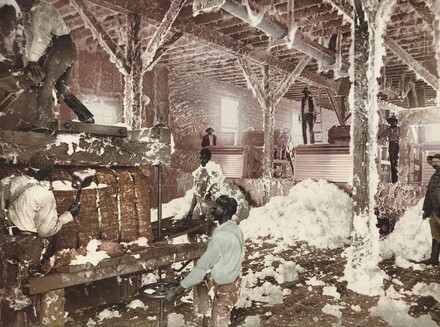
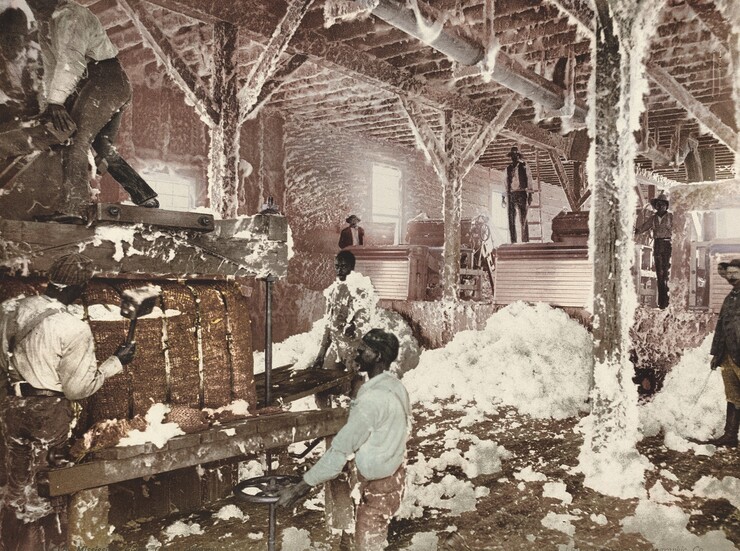
American 19th Century, Detroit Photographic Company, Mississippi Cotton Gin at Dahomey, published 1899, photo-chromolithograph, Gift of Mary and Dan Solomon and Patrons' Permanent Fund, 2006.133.130
How did the Industrial Revolution change the United States?
What makes industrialization possible?
How does art reverberate the varying experiences within a capitalist economic system?
In 1899 an unknown lensman documented the interior of a cotton wool gin operation in Dahomey, Mississippi. The image reveals the challenging and stifling work of processing raw cotton in the humidity of the southern United States. In the foreground, African Americans pack and press cotton into a massive bale. Others stand in the groundwork next to cotton gins, machines that separated sticky seeds from plant fibers. Cotton clings to the walls and rafters of the room.
Past 1860, 61 percent of the world's raw cotton originated in the southern United States. Nearly all of this cotton was grown and processed by enslaved African Americans on lands seized from Native Americans. The cotton was shipped to industrial giant Nifty Britain, which imported 75 percent of its raw cotton from the U.s.a., too as to factories in the northern U.s.a., where the cobweb was spun, dyed, woven, and printed. Cotton was cardinal to the United states becoming a global economic powerhouse.
The outset of the Usa Industrial Revolution is often dated to 1793, when the outset h2o-powered, roller-spinning cloth mill opened in Pawtucket, Rhode Isle. It was developed in part by Samuel Slater, an English textile apprentice who memorized British mill designs—in defiance of British laws banning their export—and and then immigrated to the United States.
This origin story introduces two themes that frequently feature in the larger narrative of industrialization: entrepreneurship and mechanization. Information technology centers the Industrial Revolution in New England, where textile mills proliferated due to fast-running rivers and where workers left farms for factories over the second one-half of the 19th century. It too celebrates the United States as a champion of opportunity for immigrants who moved to the young land by the millions.
However, the story of the Industrial Revolution in the Usa is also the story of slave labor, land exploitation, and Indian Removal. Mississippi Cotton Gin at Dahomey documents mechanized labor at what was one time the globe'due south largest cotton fiber plantation. Situated in the soil-rich area known equally the Mississippi delta, Dahomey Plantation was named later on the homeland of its enslaved workers, the Kingdom of Dahomey in present-twenty-four hours Benin.
The drive to industrialize, compete, and rapidly increase wealth in the United States impacted people and lands unevenly. Artists, peculiarly photographers, were hired to celebrate industrial achievements, particularly the construction of railroads. These same works of fine art often reflect the unease, tension, and loss that resulted from such development. By looking at artwork from this flow, how might we proceeds a fuller flick of the innovations and sacrifices that led to the growth of the United States?
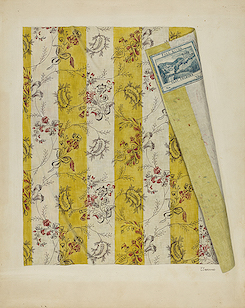
Industrial Revolution Joseph Lubrano, Printed Textile, c. 1941, watercolor on paperboard, National Gallery of Art, Washington, Index of American Blueprint, 1943.8.950
Cotton played a key function in the United States' Industrial Revolution. By the mid-19th century, the U.s. supplied 61 pct of the earth'due south raw cotton, all of it grown in southern states. Textile mills in New England used raw cotton wool from the South to spin, dye, and eventually weave and impress cotton material.
This textile sample—rendered in watercolor by an creative person hired in the 1930s—was produced by the Robeson Visitor in Fall River, Massachusetts, between 1834 and 1848. The illustration is part of the Index of American Design, a drove of eighteen,257 watercolor renderings of American folk and decorative arts objects from the colonial period through 1900. Illustrators were hired by the federal government every bit office of a Depression-era work-relief program to document the "usable past" and preserve a national artful.
What piece of design or material culture from today would yous preserve for future generations?

Industrial Revolution American 19th Century, Textile Merchant, c. 1840, oil on canvas, National Gallery of Fine art, Washington, Gift of Edgar William and Bernice Chrysler Garbisch, 1953.5.81
Past the 1840s, when this portrait was made, textile mills had spread throughout New England. This merchant's portrait is evidence of that growing manufacture. The sitter was affluent enough to commission his portrait and is shown in front of what made him wealthy. Rather than selling bulk textiles, however, this man probably supplied dry appurtenances or manufactured dresses. Behind him are blueish boxes that would have likely independent hats; bolts of calico, a printed cotton wool fabric, sit on shelves. Multiple groups benefited from calico printing at this time, including factory owners, textile merchants, and those who created goods using the fabric.
What markers of wealth and status exercise you see in your community today?
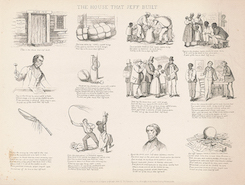
Industrial Revolution David Claypoole Johnston, The Firm that Jeff Built, 1863, etching in black on wove paper, National Gallery of Art, Washington, Corcoran Drove, 2015.xix.2810
Crops of all kinds flourished in the Southern Usa due to its warm climate, moderate rainfall, and rich soil. However, cotton fiber was a commodity in loftier demand in the 19th century, and its growth and processing were made easier by the invention of the cotton gin in 1793 and the discovery of a new cotton species. These factors encouraged Southern planters to focus their growing efforts on the crop, and slaveholders increased their output by relying more heavily on enslaved human capital.
The House that Jeff Built is an abolitionist political drawing made in 1863 during the Civil War. David Claypoole Johnston borrowed the structure of the British nursery rhyme "This Is the House That Jack Built" to illustrate how slavery and the cotton economic system, led by Confederate President Jefferson Davis, were interdependent and dehumanizing.
According to this drawing, what is the downfall of the Confederacy?
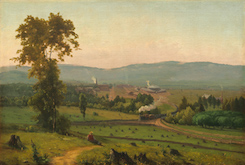
Industrial Revolution George Inness, The Lackawanna Valley, c. 1856, oil on canvas, National Gallery of Fine art, Washington, Gift of Mrs. Huttleston Rogers, 1945.4.1
The Delaware, Lackawanna, and Western Railroad, based in Lancaster, Pennsylvania, hired George Inness to depict and gloat the railroad soon afterward its 1851 incorporation. Inness's painting features a train moving through a field of tree stumps, a sight increasingly common beyond the country every bit railroads were rapidly synthetic in the second half of the 19th century. A roundhouse, depicted in the background, was not yet finished when Inness made the painting, but his patron requested it be included in the work.
Some scholars translate this painting as an enthusiastic affirmation of industrial technology. Others understand it to be a lament for a apace vanishing wilderness. Given what yous run across in the painting, what exercise you remember this artwork's message is?
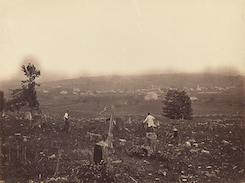
Industrial Revolution Thomas H. Johnson, Waymart, c. 1863–1865, albumen impress, National Gallery of Art, Washington, Gift of Mary and Dan Solomon, 2006.131.v
In 1863 Thomas H. Johnson opened a photographic studio in Scranton, Pennsylvania, where he had easy access to clients in the coal and railroad industries. The Delaware and Hudson Canal Company (who subsequently built the Delaware and Hudson Railway) hired Johnson to create a serial of photographs depicting mining towns along railroad routes. Delaware and Hudson played a major function in developing and operating coal mines in northeast Pennsylvania. In this photograph, Johnson focused his camera on Waymart, a town that had sprung up along the railroad.
Compare this photograph to George Inness'due south painting, The Lackawanna Valley. What similarities and differences do you meet?
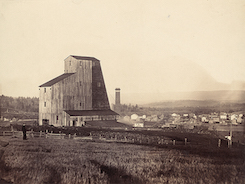
Industrial Revolution Thomas H. Johnson, Von Storch Shaft, Del. & Hudson Canal Co., c. 1863–1865, albumen impress, National Gallery of Fine art, Washington, Alfred H. Moses and Fern K. Schad Fund, 2016.152.i
As part of a serial documenting coal mines for the Delaware and Hudson Culvert Company, Thomas H. Johnson set his camera upon this imposing construction gear up atop a mine opening in Scranton, Pennsylvania. Consider how Johnson shows the construction in comparing to the town and landscape. What do you think this photograph says about the coal industry?
There are more photographs of 19th-century railroads and industrial scenes than paintings. This is due in large function to the recent invention of photography in 1839. Photographers aligned themselves to modernistic industry and railroads preferred using the latest art grade to promote their enterprise.
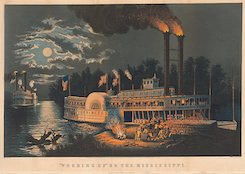
Industrial Revolution Frances Flora Bond Palmer, "Wooding Up" on the Mississippi, 1863, color lithograph with paw-coloring on wove paper, National Gallery of Art, Washington, Donald and Nancy deLaski Fund, 2011.30.one
Steamboats dramatically altered transportation in the United states of america in the late 18th and early on 19th centuries. Powered by lumber or coal, steamboats replaced one-manner flatboats, enabling faster 2-way travel via canals and rivers. They also held greater capacity for conveying goods. Steamboats hastened the spread of settlers into what is now the eye of the United states, particularly forth the Mississippi and Ohio Rivers.
"Wooding Up" on the Mississippi from 1863 shows the showboat Princess stopping for fuel, perhaps in a race with Diana behind it. African Americans, probable enslaved, load lumber onto the boat, while white patrons, some of them slaveholders, populate the upper deck. In this work, Frances Flora Bond Palmer may have been hinting at the dangers of steamboat travel: moonlight shines on a snag (or tree) in the river, and the glowing fires would accept reminded viewers of the all-too-common upshot of ship explosions. Palmer likely knew about the 1859 explosion of the showboat Princess in New Orleans, when dozens died because of faulty boilers.
Recall almost the details and themes presented in this work of art. If this image appeared in a newspaper, what exercise y'all think the adjacent headline might read?
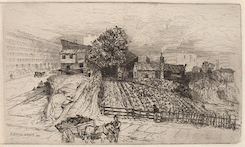
Industrial Revolution Mary Nimmo Moran, A Urban center Farm—New York, 1881, etching in black, National Gallery of Fine art, Washington, Reba and Dave Williams Drove, Souvenir of Reba and Dave Williams, 2008.115.3579
Mary Nimmo Moran was widely celebrated as an adept engraver in the 1880s and 1890s. Her depiction of industry surrounding a pocket-size vegetable subcontract frankly illustrates the transition from agrarian to urban life that took place in the United States in the 19th century. In this etching, Nimmo Moran emphasized the farm'southward stature by using heavier, darker lines in the printing process. She exposed that part of the copper plate to extra acid, which ate more deeply into the lines she had etched. Every bit a result, these lines held more ink and appeared more saturated and bolder than the faint, soft outlines of the factories and high-rises.
Many US artists working at this time chose to flee from cities, especially New York, making intimate works depicting the landscape as a form of escape and relief from the stresses of modernistic life. These subjects appealed to many looking to buy works of fine art.
Who practise you imagine might accept purchased a impress like this? What kinds of contrasts do y'all see in the built environs where y'all live?
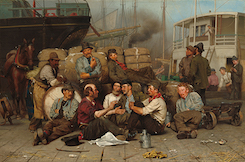
Industrial Revolution John George Brownish, The Longshoremen's Noon, 1879, oil on canvas, National Gallery of Art, Washington, Corcoran Drove (Museum Purchase, Gallery Fund), 2014.136.two
Painter John George Brown kept a studio in New York a few blocks from the Hudson River. He often walked down to the docks, where he paid longshoremen more than their going rate to pose for sketches. The Longshoreman's Noon illustrates a diversity of Irish and German workers, as well as a sole African American man, sitting on and in front end of bales of cotton fiber set to ship.
Earlier the advent of the shipping container, longshoremen were essential to waterfront operations. They loaded and unloaded ships, moving hundreds of pounds of cargo that physically taxed their bodies. Piece of work was often erratic, appearing and disappearing with the whims of shipping schedules, and steamships paid wages depending upon prevailing economic atmospheric condition. New York longshoremen went on strike multiple times in the late 1870s, while Brownish worked on this painting. It is idea that the men at center are discussing news of their efforts published in the Sun newspaper.
Journalists criticized Brown for idealizing his subjects, including these longshoremen. He avoided showing the total realities and challenges of urban life, acknowledging that he made works of art for the public and collectors to enjoy. Knowing its groundwork, what do you think near this painting?
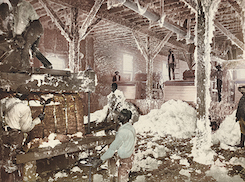
Industrial Revolution Detroit Photographic Company, Mississippi Cotton Gin at Dahomey, published 1899, photo-chromolithograph, National Gallery of Art, Washington, Gift of Mary and Dan Solomon and Patrons' Permanent Fund, 2006.133.130
What do you picture when you think of cotton wool?
This photograph shows the interior of what was once the world's largest cotton plantation. At left, African American men pack cotton into a big bale using a printing; in the rear, cotton gins—machines that separate gluey seeds from constitute fibers—are visible. Eli Whitney's invention of the cotton gin in 1793 accelerated cotton production in the United States, also every bit the use of slave labor to harvest and process the ingather. By 1899, when this photo was made, slavery had been abolished for over 30 years, but cotton fiber production was rebounding.
Dahomey Plantation was founded in 1833 past F. Grand. Ellis, who named the plantation after the Kingdom of Dahomey, the homeland of his enslaved workers in nowadays-day Benin. Ellis was probably able to claim the land at this time because thousands of Native Americans had been forcibly removed under policies and orders enacted by President Andrew Jackson.
Imagine yourself in this scene: What do you think it would have felt similar to work in this room? How does knowing the history of Dahomey Plantation and its land modify your thinking almost the photograph?
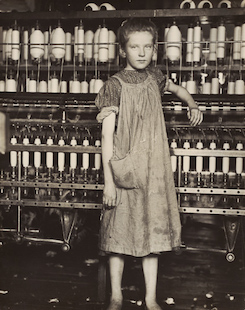
Industrial Revolution Lewis Hine, Addie Carte, 12 years old. Spinner in cotton mill, North Pownal, Vermont, 1910, gelatin silverish print, National Gallery of Art, Washington, Pepita Milmore Memorial Fund, 2014.164.i
Addie Carte du jour was one of thousands of child workers whom Lewis Hine documented for the National Child Labor Commission from 1908 to 1924. The organization hired him to investigate and photograph child labor practices beyond the United States.
Child labor increased in the 19th century equally factories and industries grew, and information technology was especially common in material mills. Families relied on their children for income and employers took advantage of their minor bodies and fingers to fix machines and fit into small spaces.
Lewis Hine's photographs drew attending to unfair and unsafe child labor practices. Simply it was not until 1938 that the Off-white Labor Standards Act was passed, regulating child labor—though agronomical labor was and still is excluded. Imagine yourself in Addie Bill of fare'due south place. What do yous recollect a typical twenty-four hour period in her life would have been like?
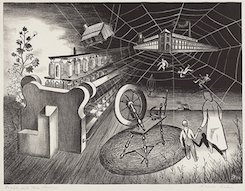
Industrial Revolution Lamar Baker, Walk Into My Parlor, 1940, lithograph, National Gallery of Art, Washington, Reba and Dave Williams Collection, Gift of Reba and Dave Williams, 2008.115.731
This impress shows a montage of images related to the cotton industry in the Southward. In the foreground, a mother and child walk away from a spinning wheel toward a cotton mill, which has caught other workers in its spider web. A alpine cotton plant on the left is juxtaposed with factory machinery.
By the 1930s, many southerners were trapped in the cotton wool industry'southward cycle, growing the crop for cash and working the mills even every bit the market plummeted. The region'southward longtime reliance on cotton and its lack of manufacture diversification and task opportunities led to widespread poverty.
Lamar Baker, an artist built-in and raised in Atlanta, said his objective was to make "social and moral comments by mode of the lithographer'southward art." What social or moral commentary do you run into in this work?
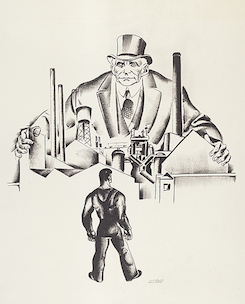
Industrial Revolution Hugo Gellert, Chief Accumulation 3, 1933, lithograph, National Gallery of Art, Washington, Reba and Dave Williams Drove, Gift of Reba and Dave Williams, 2008.115.2026
Hugo Gellert made Primary Accumulation 3 for an illustrated volume of Karl Marx'due south Das Kapital. Das Kapital was written in the mid-19th century as the Industrial Revolution fundamentally altered piece of work and life. Marx studied the English mill system and theorized that capitalism, with its ceaseless bulldoze for profits and power, exploited workers and would eventually plummet.
Gellert selected what he chosen "essential parts" of Das Kapital and created corresponding prints. With this work, Gellert illustrated an aspect of primary (or primitive) accumulation, a concept which Marx described as a precapitalist phase wherein owners merits capital, often seizing it from others, in order to begin the capitalist wheel. Gellert shows the owners of production as more powerful and distinct from the working class. How does Gellert demonstrate the factory owner'south ability?
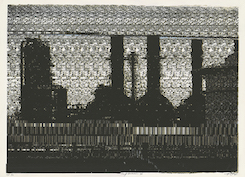
Industrial Revolution Soledad Salamé, Gulf Distortion XII, 2011, color screenprint with interference pigments on plastic moving-picture show, National Gallery of Art, Washington, Gift of Bob Stana and Tom Judy, 2016.148.46
Soledad Salamé traveled to Louisiana to certificate the aftereffects of the 2010 Deepwater Horizon oil spill. The well, operated by BP, spilled four.ix meg barrels of oil into the Gulf of Mexico over the course of at least five months, making it the largest marine oil spill in history. This industrial disaster continues to negatively impact body of water life and people living forth the coast.
To create her Gulf Distortion serial, Salamé faxed the photographs to herself, deliberately distorting the images. She printed them on plastic film using an ink that produces a shimmery appearance. Why do you retrieve she may have distorted the original photographs in this mode?
The Deepwater Horizon disaster raised questions about the petroleum industry, its environmental impacts, and how information technology is regulated. Compare this photo to Von Storch Shaft, Del. & Hudson Canal Co. by Thomas H. Johnson. What similarities and differences practise y'all come across between these two works of art?
0 Response to "How Did the Industriel Revolution Create New Ways of Art"
Post a Comment