what factors cemented scs return to the republican party
It'south become commonplace among observers of U.S. politics to decry partisan polarization in Congress. Indeed, a Pew Enquiry Center analysis finds that, on boilerplate, Democrats and Republicans are further apart ideologically today than at any time in the past 50 years.
Only the dynamics behind today's congressional polarization have been long in the making. The analysis of members' ideological scores finds that the electric current collision betwixt Democrats and Republicans is the effect of several overlapping trends that accept been playing themselves out – and sometimes reinforcing each other – for decades.
- Both parties have grown more than ideologically cohesive. There are now just about two dozen moderate Democrats and Republicans left on Capitol Colina, versus more than than 160 in 1971-72.
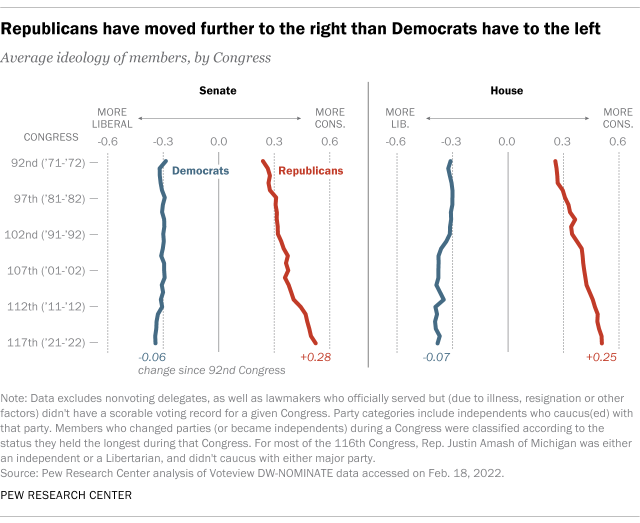
- Both parties have moved farther away from the ideological middle since the early 1970s. Democrats on average have become somewhat more than liberal, while Republicans on average have become much more conservative.
- The geographic and demographic makeup of both congressional parties has changed dramatically. Nearly half of House Republicans now come from Southern states, while nearly one-half of House Democrats are Black, Hispanic or Asian/Pacific Islander.
The Eye'south analysis is based on DW-NOMINATE, a method that uses lawmakers' roll-call votes to identify them in a ii-dimensional ideological space. It is designed to produce scores that are comparable across time. This analysis focuses on the kickoff dimension, which is essentially the economic and governmental aspects of the familiar left-right spectrum and ranges from 1 (most conservative) to -i (most liberal). (For more than details on DW-NOMINATE and this assay' geographical definitions, read "How we did this.")
This assay is based on DW-NOMINATE, a method of scaling lawmakers' ideological positions based on their gyre-telephone call votes. It is the latest iteration of a procedure starting time developed past political scientists Keith T. Poole and Howard Rosenthal in the early 1980s.
DW-NOMINATE places each lawmaker on a two-dimensional scale, much similar a standard x-y graph. The first ("horizontal") dimension is substantially the aforementioned as the economic and governmental aspects of the familiar left-liberal/correct-conservative political spectrum. The 2d ("vertical") dimension typically picks up crosscutting issues that have divided the major parties at diverse times in American history, such as slavery, currency policy, clearing, ceremonious rights and abortion. But as Poole noted in 2017, since about 2000 that second dimension has faded in significance, to the point where congressional activity has "collapse[d] into a one-dimensional, near-parliamentary voting structure … about every event is voted forth 'liberal-bourgeois' … lines."
Appropriately, similar most political scientific discipline work that employs DW-NOMINATE scores, this assay focuses on the primary liberal/bourgeois scale. That scale runs from -1 (most liberal) to ane (nearly conservative). Each lawmaker is assigned a value betwixt those endpoints based on their voting tape; the scores are designed to be comparable betwixt Congresses and beyond time.
In mid-February 2022, we downloaded DW-NOMINATE data for all senators and representatives from the 92nd Congress (1971-72) to the current 117th Congress. We excluded nonvoting delegates from the assay, too as lawmakers who officially served only (due to health issues, resignation or other factors) didn't have a voting tape that could be analyzed and scored for a given Congress. We did include all other lawmakers who served at any time during a given Congress, including those who died mid-term; those appointed to temporarily fill Senate seats who only served for part of a term; and those who left Congress early to make full some other office, such every bit a Cabinet position. (We also included all Firm speakers, even if they didn't have an analyzable voting tape. For many years, the tradition in the House has been for speakers to vote merely on very pregnant matters or if their vote volition be decisive.)
Lawmakers who changed parties in mid-Congress were classified by whichever characterization they wore for the longest fourth dimension. Independents were analyzed as part of whichever major political party they caucused with, with the exception of Rep. Justin Amash of Michigan during the 116th Congress. (Amash left the Republican Party in mid-2019, and for most of his final term did not caucus with either major party.)
In our discussion of "Southern Democrats" and "Southern Republicans," we divers "the South" every bit the 11 states that comprised the Confederacy during the Ceremonious War, most of which were dominated politically by Democrats for generations after Reconstruction concluded. Southern Democrats, however, were ideologically and demographically quite singled-out from Democrats in the residue of the state, so they merited divide study (and we wanted to encounter if today's Southern Republicans are similarly distinctive). We chose to utilise the former Confederate states as our definition of "the South," as the states that made upwardly the so-called "Solid Southward" varied somewhat over fourth dimension and we wanted a consistent, relatively objective definition.
Our analysis of the changing racial and ethnic composition of lawmakers was based on information from the U.S. House of Representatives' athenaeum.
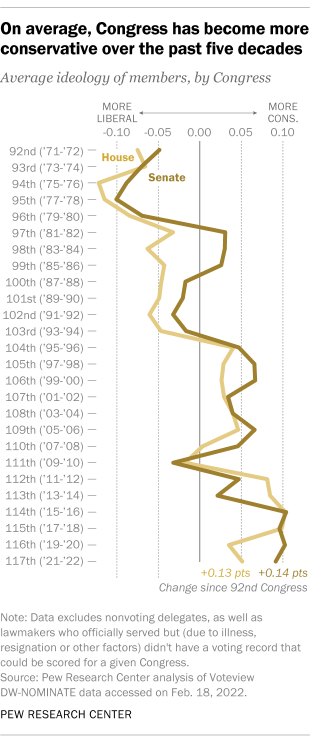
Between the 92nd Congress of 1971-72 and the electric current 117th Congress, both parties in both the House and the Senate have shifted further abroad from the center, but Republicans more then. Firm Democrats, for case, moved from almost -0.31 to -0.38, meaning that over time they've become modestly more than liberal on boilerplate. House Republicans, by dissimilarity, moved from 0.25 to well-nigh 0.51, a much bigger increase in the conservative direction.
As Democrats take grown more than liberal over time and Republicans much more than bourgeois, the "middle" – where moderate-to-liberal Republicans could sometimes find common ground with moderate-to-conservative Democrats on contentious issues – has vanished.
5 decades ago, 144 House Republicans were less conservative than the almost conservative Democrat, and 52 Business firm Democrats were less liberal than the most liberal Republican, co-ordinate to the assay. But that zone of ideological overlap began to shrink, as conservative Democrats and liberal Republicans – increasingly out of step with their caucuses and their constituents – either retired, lost reelection bids or, in a few cases, switched parties.
Since 2002, when Republican Rep. Constance Morella of Maryland was defeated for reelection and GOP Rep. Benjamin Gilman of New York retired, there's been no overlap at all between the least liberal Democrats and the least bourgeois Republicans in the House. In the Senate, the stop of overlap came in 2004, when Democrat Zell Miller of Georgia retired.
Ever since, the gaps between the to the lowest degree conservative Republicans and least liberal Democrats in both the House and Senate have widened – making information technology e'er less likely that at that place'southward any common ground to discover.
The ideological shifts in the congressional parties have occurred aslope – and, maybe to some extent, considering of – geographic and demographic shifts in their composition.
In 1971-72, representatives from the 11 former Confederate states made up nearly a third (31.4%) of all the House Democrats who served in that Congress. Those Southern representatives were notably less liberal than Democrats from elsewhere in the country: Their average DW-NOMINATE score was -0.144, versus -0.388 for non-Southern House Democrats.
Over time, though, Southern Democrats became both fewer in number and more liberal – to the point where today, they account for merely 22% of the House Democratic conclave, just ideologically are nearly indistinguishable from their non-Southern colleagues (average scores of -0.383 and -0.381, respectively).
On the Republican side of the aisle, almost the exact opposite tendency has occurred. Southerners made up less than xv% of the House GOP caucus 50 years agone but contain nigh 42% of it today. And while Republicans in general accept become more than bourgeois, that's been especially true of Southern Republicans in the House: Their DW-NOMINATE score has moved from about 0.29 (only slightly to the correct of non-Southern Republicans) in 1971-72 to 0.57 in the electric current Congress, versus nigh 0.46 today for non-Southern House Republicans. (These trends are similar in the Senate, although just four of the 22 senators from one-time Confederate states are currently Democrats.)
The racial and ethnic makeup of both parties' Southern lawmakers has changed considerably. In 1971-72, according to House records, only 12 African Americans served in the House and ane in the Senate, and none were from the South. Of the 5 Hispanics in the House, ii were from Texas (the solitary Hispanic senator was from New Mexico). And the merely Asian Americans or Pacific Islanders in Congress were Hawaii's two senators (one Democrat, i Republican) and two representatives (both Democrats).
In the current Congress, 24 of the 50 Firm Democrats from the S are African American; seven are Hispanic; and two are Asian Americans or Pacific Islanders. (Rep. Bobby Scott of Virginia is of both African American and Filipino descent.) One of the iv Democratic senators from the South (Raphael Warnock of Georgia) is African American. In contrast, only 1 of the 91 Southern House Republicans is Black (Byron Donalds of Florida); 4 others are Hispanic. Ane of the GOP's eighteen Southern senators is Black (Tim Scott of South Carolina) and two are Hispanic (Ted Cruz of Texas and Marco Rubio of Florida).
Source: https://www.pewresearch.org/fact-tank/2022/03/10/the-polarization-in-todays-congress-has-roots-that-go-back-decades/
0 Response to "what factors cemented scs return to the republican party"
Post a Comment